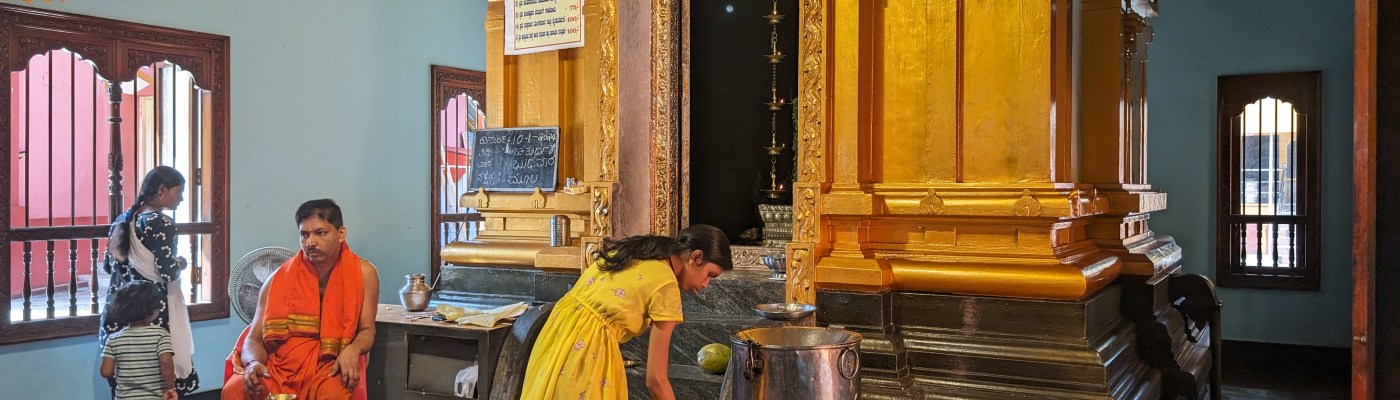
The Gokarnath Temple is a spiritual center revered throughout southern India. It’s an immense and ornate complex dedicated to Shiva. The guru who founded the temple was Narayana Guru and it was built by a local businessman in 1912. It was meant to be a temple for everyone–all castes, all religions. It even has the one female Hindu priest in India.


 |
| That is the god Shiva in the pond, which is the main god this temple is dedicated to. But the prime belief is in “one caste, one religion and one god.” |
 |
| This is one of the smaller temples in the complex dedicated to Hanuman, the monkey god. |
We visited a cashew factory where tons of cashews every week are washed, roasted, peeled, sorted and packed for export. The workers in this factory are mostly women because they are believed to have a more delicate touch and are less likely to break the cashews. For a full day’s work in this very noisy factory they earn $4 to $5.


The Saint Aloysius Chapel, built in 1885, is noteworthy for what many consider the frescos and canvases that cover its ceiling and walls. They were all painted by the Jesuit brother Antony Moscheni who came over from Italy in 1889 and completed the work in two years. It’s been compared to the Sistine Chapel. Hmm…I’ve seen the Sistine Chapel and the work is not Michelangelo. But it is an impressive accomplishment.


It was lovely to visit the Belmont House, an interesting combination of colonial Britain and traditional India. The house was built in the early 18th century by the British Collector and Magistrate of the district. Eventually the elegant home was bought by the Indian Peres family, successful coffee and rubber merchants. Today the matriarch Joan Peres lives here and graciously opens the house only to Oceania tourists. One of her sons is on the board of Oceania. Her only child still living in Mangalore, Greg, also greeted us and shared stories about the family’s life.


 |
| Joan Peres collected all kinds of artifacts from her travels many with a religious significance. We learned that when the Portuguese colonized India in the 16th century they baptized many newly converted Indians with Portuguese names. |
 |
 J and J Travel