It’s easy to wonder how this teeming, colorful, maddening city works. It’s a place where stop lights are just a suggestion, a cacophony of horns and road workers are constant part of the soundscape, the pollution is severe, and, although it is described as the wealthiest city in India, 2/3 of its populace live in great poverty. But it does work in its way. And it has developed some unique systems for using its large labor force to its advantage. It’s also known for some impressive architecture, which combines 19th century Victorian Gothic with mid century Art Deco.
Above, Joel and I are at the Gateway of India, the most recognized symbol of Mumbai. It was built by the British in honor of the visit of George V and Queen Mary. When the British rule ended in 1948 and the last soldiers left Mumbai, they departed through the Gateway. It is now a symbol of Indian independence.
Below is another view of the Gateway along the city’s Marine Drive, which is also known as the Queens Necklace.
It’s very popular for people to congregate along the waterfront and enjoy sitting and walking at the beach. But we never saw anyone sunbathing or in the water. One reason is that the water is too polluted to swim in. That yellow haze shrouding the buildings in the picture above is smog. And it’s also not culturally appropriate for Indians to publicly sunbathe. Our guide joked that if a woman showed up in a two-piece on the beach, it would probably stop traffic.
 |
| Across the plaza from the Gateway is the famous Taj Majhal Hotel. It was built in 1903 by Jamsetji Tata of the Tata group. The story goes that when Tata, at the time one of the richest men in India, was banned from Watson’s Hotel because it didn’t allow Indians, he decided to build his own hotel. Today it’s the most iconic and luxurious hotel in Mumbai. It was badly damaged in the terrorist attack in 2008, and now security makes it difficult for non residents to enter. |
 |
| A classic British style Victorian building stands next to a fine example of art deco. The contrast is frequent in the city.
|
The Dabbawallahs are a unique feature of Mumbai. These men every day collect hundreds of thousands of lunch boxes and deliver them to working people in the city. For about $12 a month, a man picks up a home cooked lunch from a housewife in the morning, brings it to a train station where another man transports it to the city and hands it off to another man for delivery. The process is reversed to return the cleaned lunch boxes in the afternoon. The men below are collecting the coded lunches for delivery.
Another only in Mumbai feature is the Dhobi Ghat below. Known as the largest open air laundry in the world, it has over 700 washing stations where over 100,000 clothes and linens are washed every day by hand. Like so much in Mumbai, it looks messy and ungainly, but it works. Every piece of laundry is returned to its proper owner.
James Ferrari, a famous Mumbai clothing designer, was gracious and charming when he gave a tour of his home in the Khotachi Wadi community. This surprising, little known enclave in Mumbai is a group of homes built over 200 years ago when the Portuguese parceled out land to the Christian Indian community. Of 60 homes in this little oasis, only 20 are left and Ferrari leads the movement working to stave off the developers who want to gobble up the rest.
The Sri Sri Radha Gopinath Temple is a center for the Krishna movement. Inside people bow and pray to the statue of Swami Prabhupada, the famous and controversial leader who brought the Hare Krishna movement to the US. Remember all those yellow robed young people begging at airports?
Below are pictures from Mani Bhaven, the house where Ghandhi lived for 17 years and molded the ideals and organization for the movement to free India. Today it is a museum.
 |
| This is Ghandhi’s room where he lived and taught. He used the simple tools here to spin cotton, an industry he promoted for India. He wanted Indians to gain the profits they lost by shipping their unfinished cotton to Britain to be processed. |
 |
| A series of beautifully made dioramas in the house tells the story of Ghandhi’s life and accomplishments. |
 |
| At night you can see Mumbai quite differently. Many of the fine building landmarks are beautifully lit. |
 |
| The streets are packed at night. It seems like a good portion of the 23 million residents go out in the cool of the evening. The shopping streets are filled with sidewalk street vendors, which are illegal. |
 |
| A view of the Marine Drive at night explains why this road is called the Queens Necklace. The glow of the streetlights create a jewel-like circle.
|
Below is the Crawford Market, Mumbai’s main wholesale market, where you see mountains of fresh fruit and vegetables, household products, candies, spices and all kinds of merchandise.
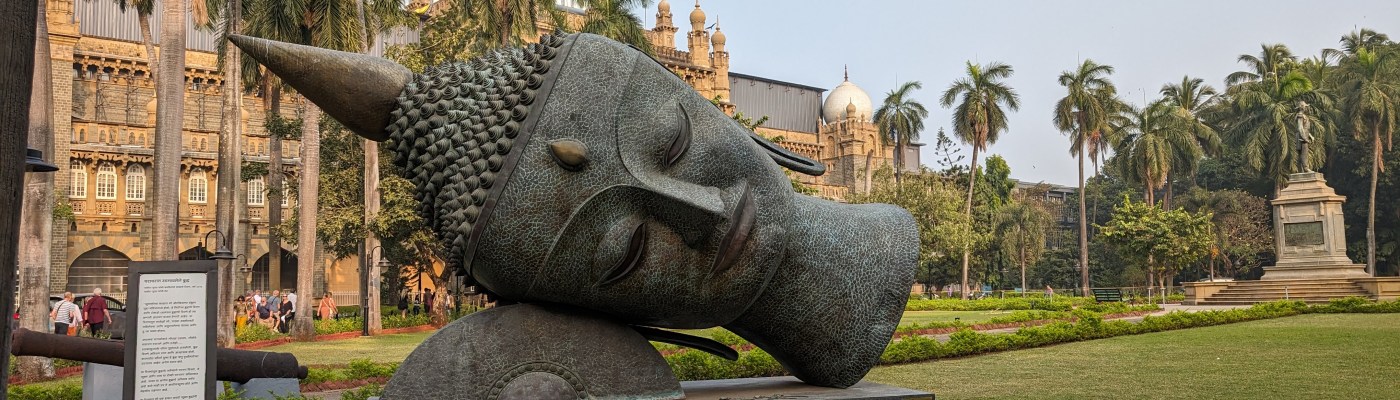
Chatrapati Shivaji Vastu Sangrahalay, formerly known as the Prince of Wales Museum was built in 1905 to mark the visit of King George V. Beautiful collection of art and artifacts documenting the history of India from prehistoric to modern times.


.jpg)


 J and J Travel