Kochi
Kochi’s prime location on the Malabar coast has long made it a crossroads of culture, diversity and trade. It’s a central point for the subcontinent’s spice trade, and it has attracted traders from all over the world. The region even had a vibrant Jewish community that dated back to the days of King Solomon and destruction of the First Temple.
Our day in Kochi started with a boat ride on its lovely harbor. The region is a series of islands and we saw views of the old and the new parts of the city.
 |
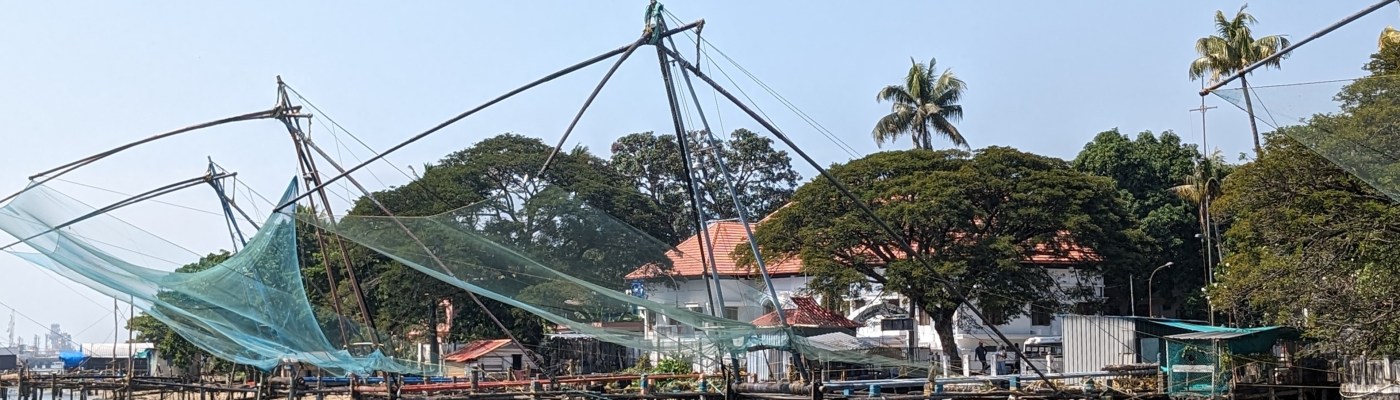
| These bird-like structures are Chinese fishing nets, so-called because the technology for them came from Chinese explorers hundreds of years ago. A lever system dips them into the water, fish swim into the nets, and the lever raises them again, scooping up the fish. Today the picturesque nets are also a tourist attraction. |
 |
| The lovely buildings on this little island go back to the days of rich Dutch landowners. Today this is a popular resort. |
 |
| These colorful fishing boats are a common sight on the harbor. Fishing and trading spices and all kinds of goods are the major part of the local economy. |
 |
| This view looks over to the newer area of the mainland. Kochi had a more prosperous, cleaner feel than some other places we visited. Our guide told us that this southern region was much better off. “Up north they have beggars and garbage on the streets. You don’t see that here.” |

We took a walk on the promenade along the waterfront. The tree shaded area attracts families, fishermen pulling their boats up to shore (below) and plenty of street vendors.


Below is the St Francis Assisi Church, originally built by the Portuguese in 1503 and one of the oldest European churches in India. The Dutch rebuilt the church in their style when they wrested control of Kochi from the Portuguese more than a hundred years later. Inside the vaulted ceiling is built like a ship’s hull in honor of the area’s maritime trade. The Portuguese explorer Vasco de Gama’s tomb is here, but his body was removed and brought back to Portugal by his son.


The story of the Jews of Kochi is a fascinating one. The first Jews were believed to have arrived in the first century BCE after the destruction of the second temple, although some sources date them back to hundreds of years earlier. They settled north of Kochi where the tolerant Maharaja of the time accepted them and gave them a plot of land. They were useful citizens as they pioneered bringing the spice trade to the area. Later, when their land flooded, they moved to present day Kochi. By the 16th century when Jews were escaping the inquisition in Spain and Portugal they found a surprisingly welcoming society here. They mixed well with their Hindu and Muslim neighbors and shared their traditions and festivals with them.
At its peak more than 3,000 Jews lived in this little area still called Jew town. Today only a very few are left. But they didn’t leave because of persecution. They were welcomed into the state of Israel when it formed in 1948. Kochi also had India’s only Communist government and they were doing forced land distribution, which affected the Jews. But although the Jews no longer own all the buildings, stores and homes on these streets, their presence is still proudly displayed in shop and signs and the Stars of David on streetlamps and carved into the walls of buildings. Among the dozens of shops selling Persian antiques, pashmina shawls and Islamic handicrafts, some pieces of Judaica are available.

 |
| The building at the end of this street is the more than 450-year-old Paradesi Synagogue. There is no longer a ten-man minyan available to have prayers here as required by the Jewish faith. |


 |
| Sarah Cohen died a few years ago in her 90’s. She didn’t have a member of her community to marry, so she had a Muslim partner and the shop went to his family. But her name and some of her hand embroidery is on display. |
 J and J Travel